Most couples spend months choosing a band for the reception and almost no time thinking about who plays during the fifteen minutes that actually start the marriage. That’s backwards. The ceremony is the part of the day with the least room for error; there’s no crowd noise to cover a missed cue, no dance floor to redirect attention if something feels off, and the two people it matters most to are standing still, facing forward, listening.
Ceremony music has a different job than reception music. It’s not there to energize a room; it’s there to carry emotional weight in total silence, in front of a seated, attentive audience, often outdoors or in a space with unpredictable acoustics: a garden, a rooftop, a church with fifty-year-old sound issues nobody’s fixed. That’s a specific skill set, and it’s why The Ceremony is treated as its own configuration rather than a scaled-down version of the reception band.
What’s included?
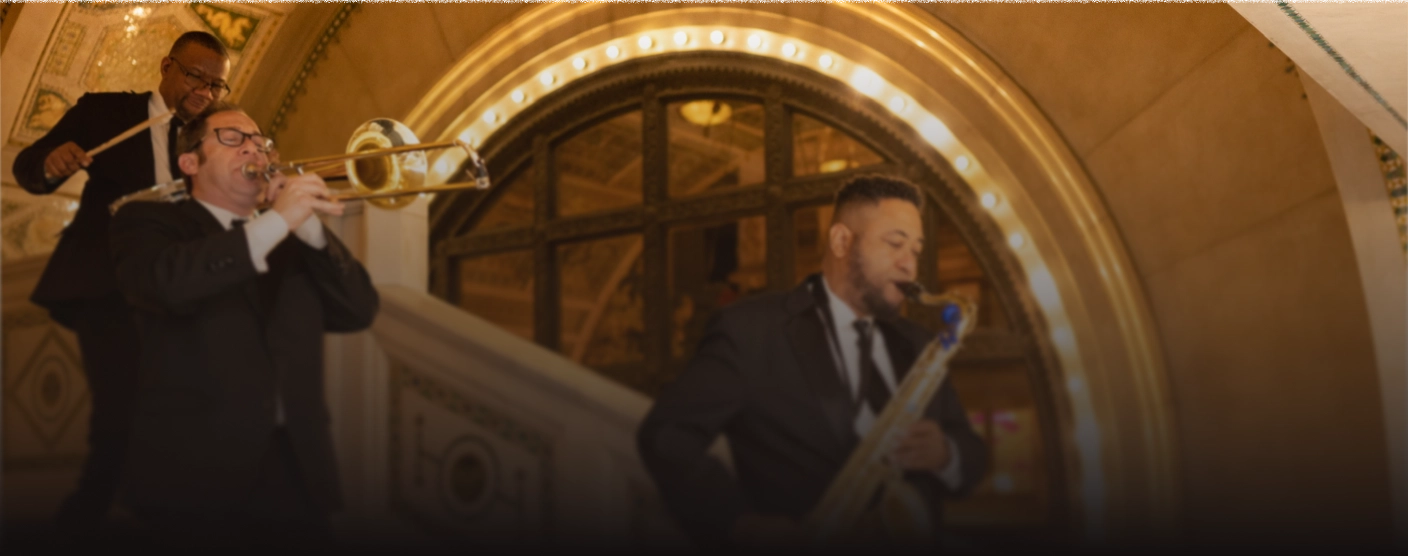
Depending on your venue, guest count, and taste, this can be a solo pianist, a string duo or quartet, or a stripped vocal-and-guitar arrangement. Each option is chosen for how it performs unamplified or lightly amplified; the arrangements aren’t reduced-instrumentation versions of full-band charts; they’re built from the ground up for a quiet room.
The structure of a ceremony set.
Most ceremonies break into four moments, each with a different musical job:
- Prelude — Music playing as guests arrive and take their seats, roughly 15–20 minutes of unobtrusive material that sets a tone without demanding attention.
- Processional — The entrance music for the wedding party and, separately, the couple. These are often two different pieces, chosen deliberately for pacing.
- Interlude — Any music played during a unity ceremony, sand pouring, candle lighting, or a quiet pause built into the vows.
- Recessional — The exit music, almost always more upbeat than everything before it, since it’s the first note of celebration after the vows are signed.
Choosing the songs.
A lot of couples default to the two or three ceremony songs everyone’s heard a hundred times. There’s nothing wrong with the classics, but this is also the one part of the day where a genuinely personal song choice, something that means something to just the two of you, even if no other guest recognizes it, lands harder than anywhere else. If you have something specific in mind, from a solo piano arrangement of a song that matters to you to a string quartet version of something unexpected, it’s worth bringing to the conversation early so it can be properly arranged rather than adapted on short notice.
Logistics that matter more here than anywhere else.
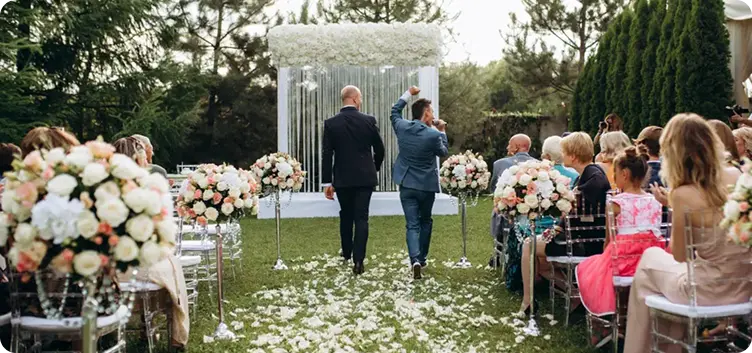
Outdoor ceremonies need a real conversation about sound, wind, traffic noise, and open space; all behave differently than an indoor room, and what worked at another couple’s ceremony at a different venue won’t automatically work at yours. If your officiant is using a microphone, that needs to be coordinated with the musicians in advance so there’s no feedback or overlap. And if your ceremony and reception are in different rooms or different venues entirely, this package can run independently of anything booked for later in the day.
Questions worth asking before you book ceremony music.
Is the space indoor or outdoor, and if outdoor, do you have a backup plan for bad weather?
Does the venue allow amplification, or does it need to stay fully acoustic?
How far is the seating from where the musicians will be set up, and does that distance change what instrumentation will actually carry?
Is there a rehearsal or walkthrough scheduled, and will the musicians be present, or will they just be briefed on the timing afterward?
None of these are complicated questions, but they’re the ones that prevent a ceremony from running into a problem nobody thought to flag in advance: a pianist who shows up to discover there’s no real piano, only a keyboard with different action; a string quartet expected to project across a garden with wind working against them; an officiant’s lapel mic bleeding into an acoustic guitar’s pickup.
Timing, more precisely.
A typical ceremony musical program runs 20–30 minutes start to finish once you include prelude music before guests are fully seated. Processional music is usually kept to one to two minutes per entrance, enough to cover the walk without dragging it out, while a recessional tends to run slightly longer and louder, since it’s doing double duty as the first celebratory moment of the day. If your ceremony includes readings, a unity ritual, or any other pause in the program, it helps to flag those moments specifically, since silence at the wrong time can feel like a mistake even when it’s intentional, and a few bars of interlude music placed correctly can smooth a transition that would otherwise feel abrupt.
Who is it Best for?
Couples who want a standalone ceremony musician or ensemble, couples booking ceremony and reception music from different vendors, and any wedding where the ceremony space has its own acoustic challenges that deserve dedicated attention rather than an afterthought.
Less of a fit if: You want the same musicians playing your ceremony to seamlessly continue into cocktail hour and reception, in that case, a bundled package like The Intimate or The Classic, which includes ceremony coverage as part of a full-day booking, will be more efficient and usually more cost-effective than booking ceremony music separately.